Personal Loans in West Virginia: What Licensed Lenders May Charge
West Virginia caps finance company loans by size: the larger the loan, the lower the rate allowed. Here is how the tiers work under the Consumer Credit and Protection Act, who needs a license, and where to check a lender.
Cap 36% or less, by LendCedar Editorial Team Updated 5 minute read
In short
A company that makes regulated consumer loans in West Virginia needs a license from the commissioner under article 4 of the West Virginia Consumer Credit and Protection Act, chapter 46A. Under W. Va. Code § 46A-4-107, the rate may not exceed 31% a year on unsecured loans of $3,500 or less, 27% on loans above $3,500 up to $15,000 and 18% above $15,000, with fees limited to about 2% of the amount financed. All in, that allows about 33% APR on a $2,000 two-year loan and about 27% on a $10,000 five-year loan.
- $2,000 loan cap
- 33% APR
- $10,000 loan cap
- 27% APR
- Rate tiers
- 31% / 27% / 18%
- Licensed by
- WV Division of Fin. Inst.
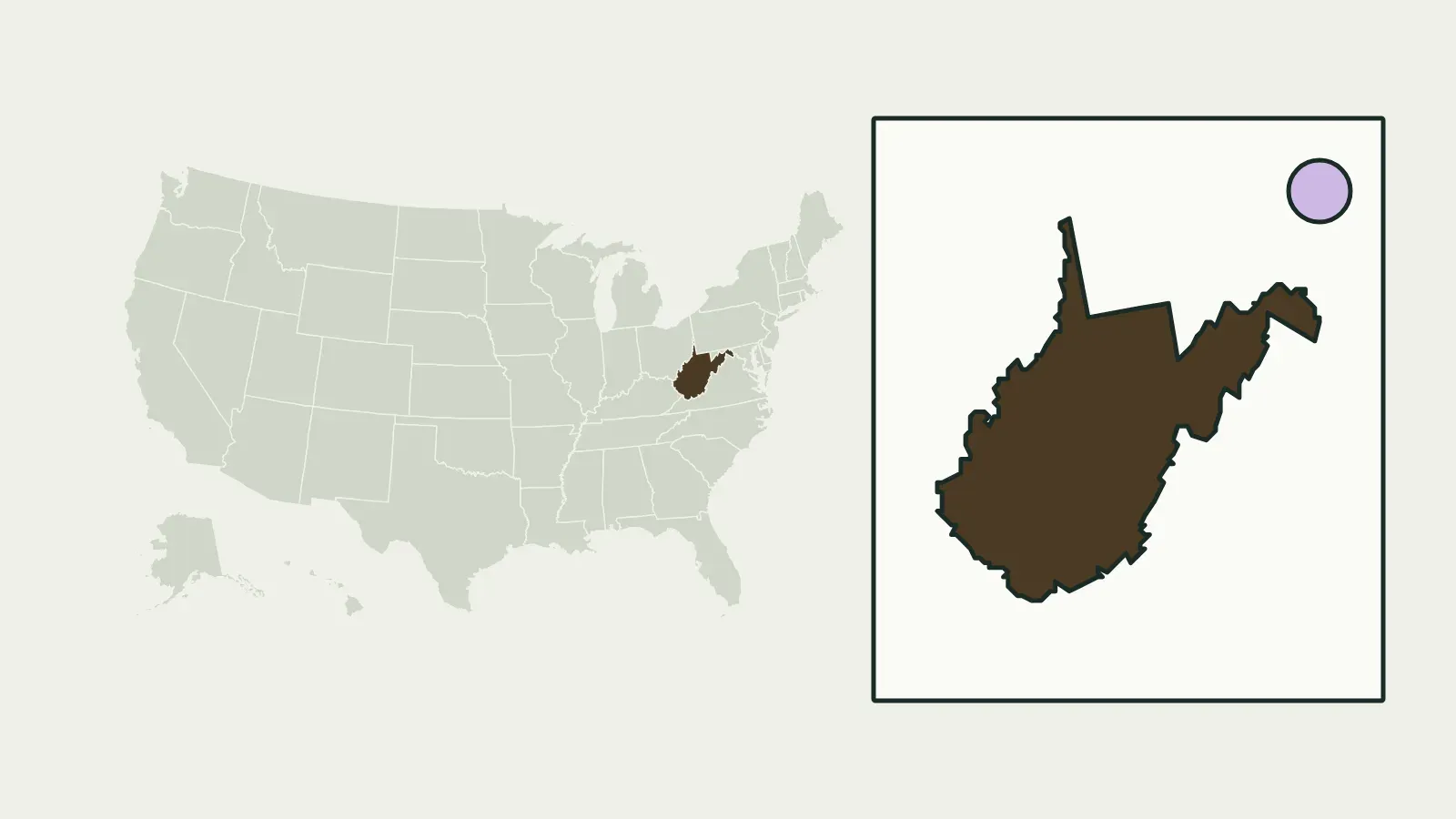
West Virginia at a glance
How the West Virginia rate tiers work
Section 46A-4-107 sets the most a regulated consumer lender may charge, as a yearly rate on the unpaid principal balance under the actuarial method. Unlike states that blend rates across slices of one loan, West Virginia sets the rate by the size of the whole loan.
| Loan | Maximum yearly rate |
|---|---|
| Unsecured, $3,500 or less | 31% |
| Above $3,500 up to $15,000, or secured by real property | 27% |
| Above $15,000 | 18% |
On a nonrevolving loan above $3,500, origination fees, points and investigation fees together may not exceed 2% of the amount financed; on a loan secured by real estate the limit is 5%. On an unsecured loan of $3,500 or less, the lender may instead charge the 31% rate plus a nonrefundable processing fee of up to 2% of the amount financed, with no other finance charge.
Here is the small-loan case worked out. Borrow $2,000 for 24 months at 31% with a $40 processing fee added to the balance: the payment is $115.11, you repay $2,762.64 in all, and the APR on your Truth in Lending disclosure comes to about 33.2%. These figures are an example, not an offer.
How West Virginia compares with its neighbors
On the NCLC comparison of a $2,000 two-year loan, Pennsylvania caps that loan at about 24% APR, Maryland at 30% and Ohio at 31%, while Kentucky allows about 42% and Virginia about 50%. If you live near a state line, your state of residence and the lender's license decide which rules apply, not where the lender is based. The state rules map shows every state side by side.
Who needs a license and who does not
Under W. Va. Code § 46A-4-101, no one may make regulated consumer loans, or take assignments of, collect on or enforce such loans, without first getting a license from the commissioner. The West Virginia Division of Financial Institutions supervises regulated consumer lenders, which it describes as generally known as finance companies.
- State-chartered banks and credit unions are supervised by the same Division under their charters. National banks and federal credit unions answer to federal regulators, and a bank may charge the rates its home state allows.
- Online lenders that partner with a bank may make loans through that bank, which can put the loan outside the West Virginia tiers. Ask who the lender of record is before you sign.
- Payday and auto title loans are a separate subject. Our sister site Lendmira covers them on its West Virginia lending laws page.
If a lender asks for a fee before it will approve or fund the loan, treat it as a warning sign; how to verify a lender explains what to check.
Check a lender and file a complaint
- Look up the license in NMLS Consumer Access, or call the Division of Financial Institutions at 304-558-2294, before you apply.
- Check the rate and fees against the tiers above, and the APR on the disclosure against about 33% for a small loan.
- Keep the loan papers: the Truth in Lending disclosure, the agreement and any messages about fees. Send copies, not originals, with a complaint.
- Complain in writing to the Division using the form on its consumer complaints page, by mail to 900 Pennsylvania Ave, Suite 306, Charleston, WV 25302, or by fax at 304-558-0442.
- Send a complaint to the CFPB as well if the lender is a national bank or a bank partner, or if you are unsure who regulates it.
Sources
- W. Va. Code § 46A-4-107 — Maximum finance charges (West Virginia Legislature)
- W. Va. Code § 46A-4-101 — Authority to make loans; license (West Virginia Legislature)
- West Virginia Division of Financial Institutions — consumer complaints
- State APR caps for $500, $2,000 and $10,000 installment loans, December 2025 (National Consumer Law Center)
We checked the facts on this page against these sources on October 27, 2026. The 33.2% APR example is our own calculation from the statute's 31% rate and 2% fee.
Questions people ask
What is the maximum interest rate on a personal loan in West Virginia?
For a regulated consumer lender, 31% a year on unsecured loans of $3,500 or less, 27% on loans above $3,500 up to $15,000 and 18% on loans above $15,000, under W. Va. Code § 46A-4-107.
What fees can a West Virginia finance company charge?
On loans above $3,500, origination, points and investigation fees together are limited to 2% of the amount financed (5% if secured by real estate). On unsecured loans of $3,500 or less, a lender charging 31% may add a processing fee of up to 2% instead of other finance charges.
Do the West Virginia tiers apply to banks?
No. Banks and credit unions follow their own charters and federal law, and a bank can charge the rate allowed in its home state. The tiers bind regulated consumer lenders licensed under chapter 46A.
Where do I complain about a West Virginia finance company?
To the West Virginia Division of Financial Institutions, in writing, using its consumer complaint form. Its phone number is 304-558-2294. See how to verify a lender before you apply.
Ask lenders for real offers
Describe the loan you have in mind. LendCedar passes your request to lenders and loan brokers who may contact you with offers; you compare them and decide.
- The loan you have in mind: amount, purpose, credit and income.
- Your contact details and your consent to be contacted.
- A lender or loan broker may contact you with an offer. Nothing is decided until you sign with a lender.
LendCedar is not a lender or a loan broker and does not make credit decisions.
You pay LendCedar nothing. Lenders and loan brokers pay us for requests, and they set their own rates and terms. How we make money.
Nearby in the guide
-
Offer term
Total cost of a loan
Finance charge, APR and total of payments, with three worked offers for the same $10,000 loan.
-
Offer term
Net loan proceeds
What reaches your account when a fee is deducted, and how to gross up a loan to net the sum you need.
-
Step
Verify a lender
Find the license on NMLS or with your state, match the lender of record and spot advance-fee scams.