Personal Loans in Nebraska: What Licensed Lenders May Charge
Nebraska caps installment loans from licensed lenders with two rate tiers and an origination fee. The law was reorganized in 2025 and amended again in 2026. Here is how it works and where to check a lender.
Cap 36% or less, by LendCedar Editorial Team Updated 6 minute read
In short
A company in the business of making installment loans in Nebraska needs an installment loan license from the Nebraska Department of Banking and Finance (NDBF). Section 45-349 sets the rate limit at up to 24% a year on the first $1,000 of unpaid principal and 21% on the rest, plus a nonrefundable origination fee of up to 7% of the first $2,000 and 5% of the rest, at most $500. All in, that allows about 30% APR on a $2,000 two-year loan and about 24% on a $10,000 five-year loan. Since 2025 these rules sit in the Nebraska Installment Loan and Sales Act.
- $2,000 loan cap
- 30% APR
- $10,000 loan cap
- 24% APR
- Rate tiers
- 24% / 21%
- Licensed by
- NDBF
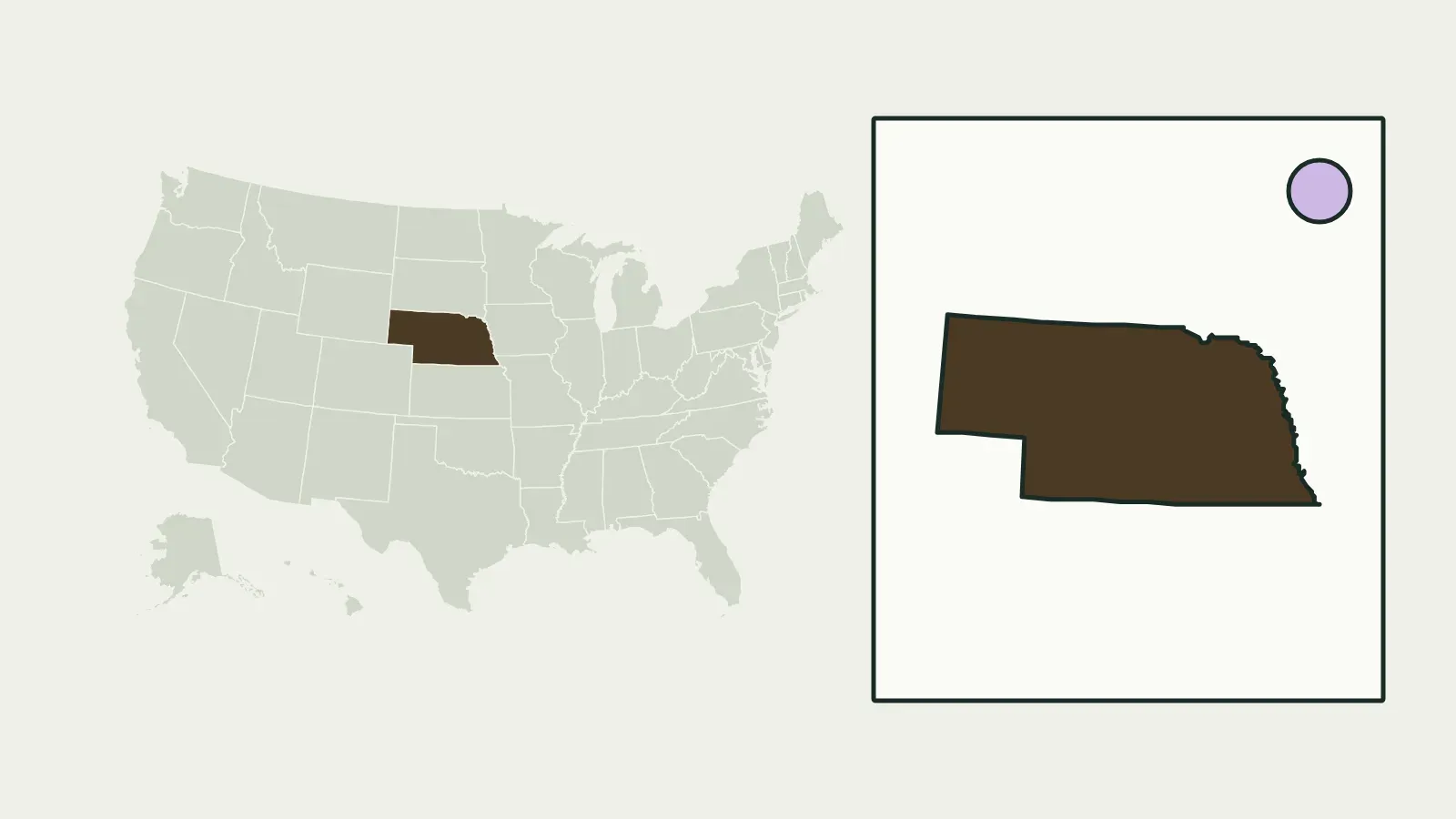
Nebraska at a glance
How the Nebraska rate tiers work
A licensed installment lender may charge more than the general usury rate, which the department's FAQ gives as 16% a year for lenders without a license. Each part of the unpaid principal carries its own maximum rate, so a larger loan has a lower blended rate.
| Part of the unpaid principal | Maximum yearly rate |
|---|---|
| Up to $1,000 | 24% |
| Above $1,000 | 21% |
The lender may also charge a nonrefundable loan origination fee, collected from you or added to the principal. Section 45-349(5) caps it at the lesser of $500 or 7% of the first $2,000 of principal plus 5% of the part above $2,000: $140 on a $2,000 loan and $500 on a $10,000 loan. If the same lender made you a loan in the past 12 months, the fee applies only to the new money. Because the fee counts as a finance charge, the APR on your Truth in Lending disclosure will be higher than the contract rate. Section 45-350 adds a term limit: on a loan with a principal balance of $3,000 or less, the contract may not require principal payments more than 36 months after it is made. A lender that breaks that rule may not collect interest or charges on the loan and must refund what it took.
What changed in 2025 and 2026
- 2025, LB 474: moved the Nebraska Installment Loan Act into the Installment Sales Act, renamed the Nebraska Installment Loan and Sales Act, sections 45-334 to 45-380. Older guides that cite sections 45-1001 and following now point to repealed numbers.
- 2026, LB 717: effective July 18, 2026, raised the threshold amount used for usury purposes and changed the definition of an installment loan in section 45-335 to match.
- Refinancing disclosure: LB 717 also requires a net tangible benefit disclosure, on a form the department prescribes, when a borrower refinances certain installment loans.
The department's notice does not state the new threshold amount. If you are refinancing, ask the lender for the net tangible benefit form and compare it with the cost of keeping your current loan.
Who needs a license and who does not
The department's installment loan FAQ says any person in the business of making installment loans needs a Nebraska installment loan license, and that the requirement reaches some who hold ownership, servicing or participation rights in those loans. Licensees may not set finance charges more onerous for some borrowers than for others of similar economic background because of protected characteristics.
- Banks and credit unions answer to separate charters and regulators. An out-of-state bank may charge the rates its home state allows.
- Online lenders that partner with a bank may lend through it, which can put the loan outside the Nebraska tiers. Ask who the lender of record is.
- Payday loans follow their own Nebraska rules. Our sister site Lendmira covers them on its Nebraska lending laws page.
Paying early and insurance
Section 45-349 sets these borrower protections on a licensed installment loan:
- Prepayment: if you pay the loan in full after the first due date, you get a rebate of unearned charges, generally figured by the actuarial method.
- Late charge: up to 5% of an installment that stays unpaid in full for 10 or more days in a row.
- Returned payment: a $15 charge, unless a third party caused the error.
- Term: no more than 145 months on most loans, and no more than 36 months of principal payments on a loan of $3,000 or less (section 45-350).
The statute also allows charges for insurance premiums and some debt cancellation products. Ask for the price with and without them; see credit insurance and add-ons.
Check a lender and file a complaint
- Look up the license in NMLS Consumer Access, which the NDBF uses for its licensee search, before you apply.
- Keep the loan papers: the Truth in Lending disclosure, the agreement and any messages about fees.
- Complain to the NDBF on its consumer complaints page, through the consumer hotline at (877) 471-3445, or at the Financial Institutions Division, (402) 471-2171.
- Send a complaint to the CFPB as well if the lender is a bank or a bank partner, or if you are unsure who regulates it.
Nearby, Colorado and Wyoming cap a $2,000 two-year loan at about 31% APR, Iowa and South Dakota at 36% and Kansas at about 38% on the National Consumer Law Center's comparison, while Missouri has no cap. The state rules map shows every state, and how to verify a lender lists the checks to run.
Sources
- Nebraska Revised Statutes section 45-349 — Installment loans; rates, origination fee and charges (Nebraska Legislature)
- Nebraska Revised Statutes section 45-350 — Installment loans; rate of interest; loan period (Nebraska Legislature)
- Nebraska Installment Loan and Sales Act, sections 45-334 to 45-380 (Nebraska Department of Banking and Finance)
- Installment Loan FAQs, revised July 2021 (Nebraska Department of Banking and Finance)
- LB 717 industry correspondence, May 18, 2026 (Nebraska Department of Banking and Finance)
- LB 474 statement of intent, 2025 (Nebraska Legislature)
- State APR caps for $500, $2,000 and $10,000 installment loans, December 2025 (National Consumer Law Center)
We checked the facts on this page against these sources on October 27, 2026. The rate tiers and fee caps are from section 45-349 as it stands after LB 474 (2025) and LB 717 (2026); LB 717 took effect July 18, 2026.
Questions people ask
What is the maximum interest rate on a personal loan in Nebraska?
For a licensed installment lender, section 45-349 allows 24% a year on the first $1,000 of unpaid principal and 21% on the rest, plus a nonrefundable origination fee of up to 7% of the first $2,000 and 5% of the rest, at most $500.
What is the Nebraska Installment Loan and Sales Act?
The 2025 law LB 474 moved the Nebraska Installment Loan Act into the Installment Sales Act and renamed it. It now covers both installment loans and installment sales, in sections 45-334 to 45-380.
What changed for Nebraska installment loans in 2026?
LB 717, effective July 18, 2026, raised the usury threshold amount, changed the definition of an installment loan and added a net tangible benefit disclosure for certain refinancings.
How do I check a Nebraska lender?
Search NMLS Consumer Access or call the NDBF consumer hotline at (877) 471-3445. See how to verify a lender.
Ask lenders for real offers
Describe the loan you have in mind. LendCedar passes your request to lenders and loan brokers who may contact you with offers; you compare them and decide.
- The loan you have in mind: amount, purpose, credit and income.
- Your contact details and your consent to be contacted.
- A lender or loan broker may contact you with an offer. Nothing is decided until you sign with a lender.
LendCedar is not a lender or a loan broker and does not make credit decisions.
You pay LendCedar nothing. Lenders and loan brokers pay us for requests, and they set their own rates and terms. How we make money.
Nearby in the guide
-
Offer term
Total cost of a loan
Finance charge, APR and total of payments, with three worked offers for the same $10,000 loan.
-
Step
Verify a lender
Find the license on NMLS or with your state, match the lender of record and spot advance-fee scams.
-
Offer term
Loan term length
How 24 to 84 months change the payment and total interest on a $10,000 loan, and how to pick a term.