Personal Loans in Iowa: What Licensed Lenders May Charge
Iowa splits the job between two laws: the regulated loan law, which licenses finance companies, and the Iowa Consumer Credit Code, which governs the loan itself. Here is how the rate limit is set, who needs a license, and where to check a lender.
Cap 36% or less, by LendCedar Editorial Team Updated 5 minute read
In short
A finance company that makes consumer loans in Iowa needs a regulated loan license under Iowa Code chapter 536, issued by the Iowa Division of Banking. The law lets the superintendent of banking set the maximum rate for regulated loans with a balance of $30,000 or less, and the Iowa Consumer Credit Code, chapter 537, applies to every consumer loan a licensee makes. The National Consumer Law Center, which compares state caps, puts the most a licensed lender may charge at about 36% APR on a $2,000 two-year loan and about 32% on a $10,000 five-year loan, fees included.
- $2,000 loan cap
- 36% APR
- $10,000 loan cap
- 32% APR
- Licensed by
- Iowa Division of Banking
- Supervised lender rate
- 21% a year
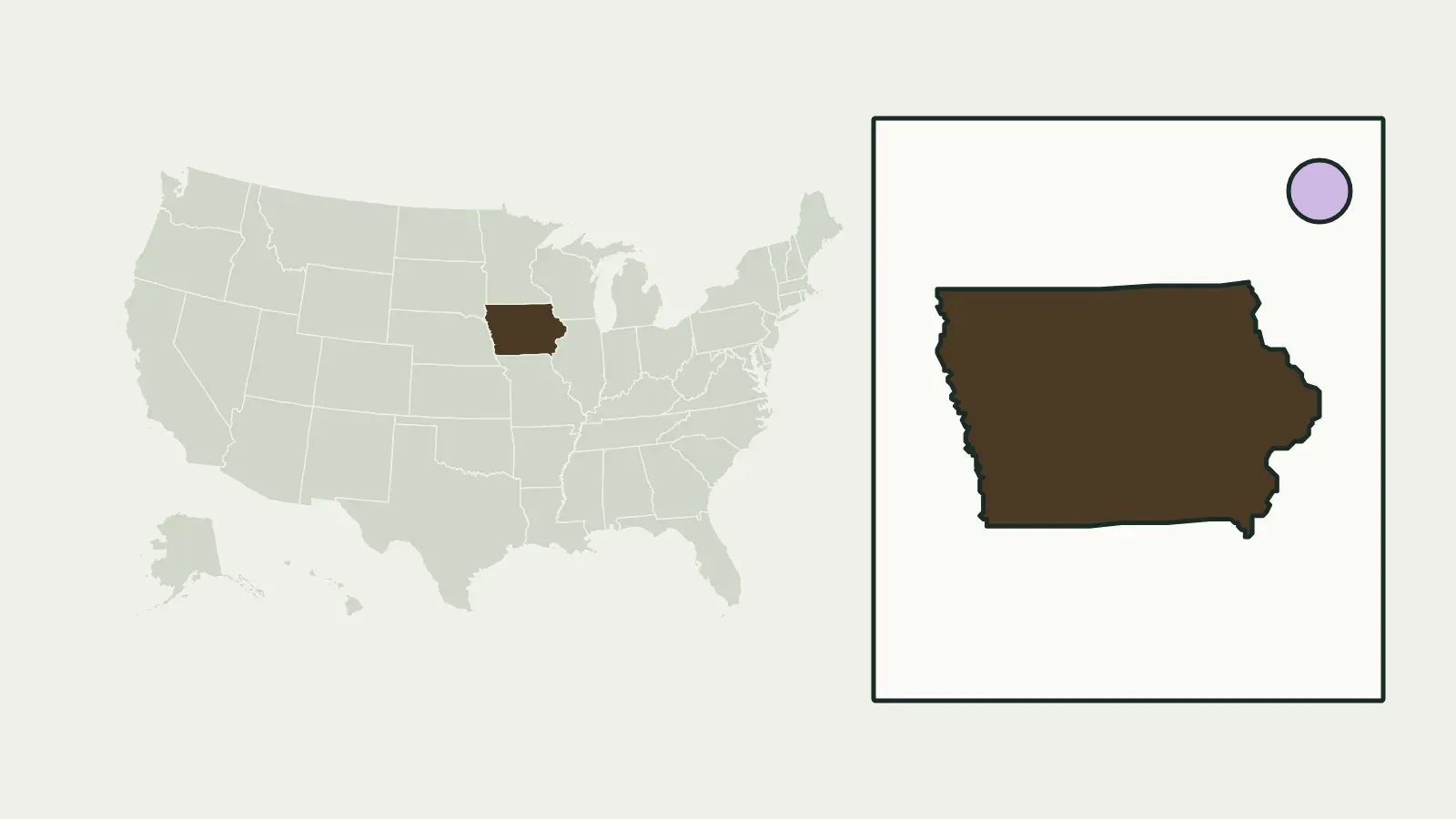
Iowa at a glance
How the Iowa rate limit works
Iowa does not print one flat cap for every lender. Its limits depend on what kind of lender you deal with, and each one is a ceiling stated as an annual percentage rate on the unpaid balance.
| Lender | Rate rule | Where it is |
|---|---|---|
| Regulated loan licensee (finance company), balance of $30,000 or less | Maximum set by the superintendent of banking | Iowa Code 536.13 |
| Regulated loan licensee, balance over $30,000 | The greater of the chapter 535 rate or the supervised lender rate | Iowa Code 536.13(7) |
| Supervised financial organization or mortgage lender | 21% a year, actuarial method | Iowa Code 537.2401 |
Section 536.13 tells the superintendent to classify regulated loans and fix a maximum rate for each class, after notice to licensees and a chance to be heard; a new rate cannot take effect until 30 days after notice and does not change loans already made. The statute also keeps a fallback schedule of monthly rates that falls as the balance grows. The rate is stated as an annual percentage rate figured by the actuarial method, the same way your Truth in Lending disclosure figures the APR, so the two numbers are directly comparable.
How Iowa compares with its neighbors
On the National Consumer Law Center's comparison of a $2,000 two-year loan, Nebraska caps the loan at about 30% APR and Minnesota at about 33%, while Illinois matches Iowa at 36%. Missouri sets no numeric cap. For a $10,000 five-year loan the gap is wider: Iowa allows about 32%, against about 24% in Nebraska and 22% in Minnesota. The state rules map shows every state side by side.
Who needs a license and who does not
A business that makes regulated consumer loans to Iowans needs a regulated loan license under chapter 536. Licensees apply and renew through the Nationwide Multistate Licensing System (NMLS), file an annual report and keep records the Division of Banking can examine. A licensee may lend up to the threshold amount set in the consumer credit code.
- Banks and credit unions answer to separate charters and regulators. The 21% rate in section 537.2401 applies to supervised financial organizations, and federal law lets many banks charge the rate allowed in their home state.
- Online lenders that partner with a bank may make loans through that bank, which can put the loan under the bank's rules instead of the regulated loan law. Ask who the lender of record is, and check that it is licensed or chartered.
- Payday and title loans follow separate Iowa rules. Our sister site Lendmira covers them on its Iowa lending laws page.
What happens if a lender overcharges
Iowa backs its rate limit with a strong penalty. If a licensee charges or receives more than chapter 536 allows, the loan is void as to interest and charges, so the lender cannot collect any of them. The lender also loses the right to collect principal: $2,000 or the whole principal of the loan, whichever is less.
Because chapter 537 applies to every consumer loan a licensee makes, a violation of the consumer credit code is also a violation of the regulated loan law. Keep your Truth in Lending disclosure and the loan agreement: the APR and finance charge on them are what you compare against the limit. If a lender asks for a fee before it will approve or fund a loan, treat that as a warning sign; how to verify a lender explains what to check.
Check a lender and file a complaint
- Look up the license on NMLS Consumer Access (nmlsconsumeraccess.org) or the Division of Banking's finance license verification page before you apply.
- Contact the lender first and keep the disclosure, the agreement and any messages about fees.
- Complain to the Iowa Division of Banking with its online complaint form, or call 515-281-4014. The division handles state-chartered banks and licensed finance companies; the lender usually has 10 to 20 business days to respond.
- Use the federal regulator if the lender is a national bank, a federal credit union or a bank partner, or send a complaint to the CFPB if you are unsure who regulates it.
Sources
- Iowa Code section 536.13, Regulated loans: rate of interest (Iowa Legislature)
- Iowa Code section 537.2401, Consumer loans: finance charge (Iowa Legislature)
- Iowa Administrative Code 187, chapter 15, Regulated loans (Iowa Legislature)
- How do I file a complaint? (Iowa Division of Banking)
- State APR caps for $500, $2,000 and $10,000 installment loans, December 2025 (National Consumer Law Center)
We checked the facts on this page against these sources on October 27, 2026. The superintendent can change the regulated loan rate by order after notice, so check the Division of Banking before you rely on an older figure.
Questions people ask
What is the maximum interest rate on a personal loan in Iowa?
It depends on the lender. For a licensed finance company, the superintendent of banking sets the maximum rate for loans of $30,000 or less under Iowa Code 536.13; the National Consumer Law Center puts the result at about 36% APR on a $2,000 two-year loan. Supervised financial organizations are limited to 21% a year under section 537.2401.
Who licenses personal loan companies in Iowa?
The Iowa Division of Banking, part of the Department of Insurance and Financial Services, issues regulated loan licenses under chapter 536 through NMLS.
What if an Iowa lender charges more than the law allows?
Under section 536.13 the loan becomes void as to interest and charges, and the lender also forfeits $2,000 of principal or the whole principal, whichever is less. Report it to the Division of Banking.
How do I check an Iowa lender?
Search the company on NMLS Consumer Access or the Division of Banking license verification page. See how to verify a lender for the other checks.
Ask lenders for real offers
Describe the loan you have in mind. LendCedar passes your request to lenders and loan brokers who may contact you with offers; you compare them and decide.
- The loan you have in mind: amount, purpose, credit and income.
- Your contact details and your consent to be contacted.
- A lender or loan broker may contact you with an offer. Nothing is decided until you sign with a lender.
LendCedar is not a lender or a loan broker and does not make credit decisions.
You pay LendCedar nothing. Lenders and loan brokers pay us for requests, and they set their own rates and terms. How we make money.
Nearby in the guide
-
Offer term
Total cost of a loan
Finance charge, APR and total of payments, with three worked offers for the same $10,000 loan.
-
Step
Verify a lender
Find the license on NMLS or with your state, match the lender of record and spot advance-fee scams.
-
Offer term
Truth in Lending disclosures
The federal box line by line: APR, finance charge, amount financed, total of payments and what sits below.