Personal Loans in Idaho: No Rate Cap, an Unconscionability Test
The Idaho Credit Code sets no maximum rate on a personal loan. A court can still refuse to enforce an unconscionable agreement, and lenders must be licensed. Here is what that means for you and where to check a lender.
No numeric cap, by LendCedar Editorial Team Updated 6 minute read
In short
Under Idaho Code 28-42-201, the finance charge on a consumer loan is whatever the lender and borrower agree to, and the lender may add other charges unless the Idaho Credit Code limits them. The check on price is Section 28-45-106: if a court finds an agreement or a clause unconscionable when it was made, it may refuse to enforce it or limit its effect. A business that makes regulated consumer loans needs a regulated lender license from the Idaho Department of Finance. With no ceiling in the law, the APR on each offer is the number that protects you.
- $2,000 loan cap
- No numeric cap
- $10,000 loan cap
- No numeric cap
- Standard
- Unconscionability
- Licensed by
- Idaho Dept. of Finance
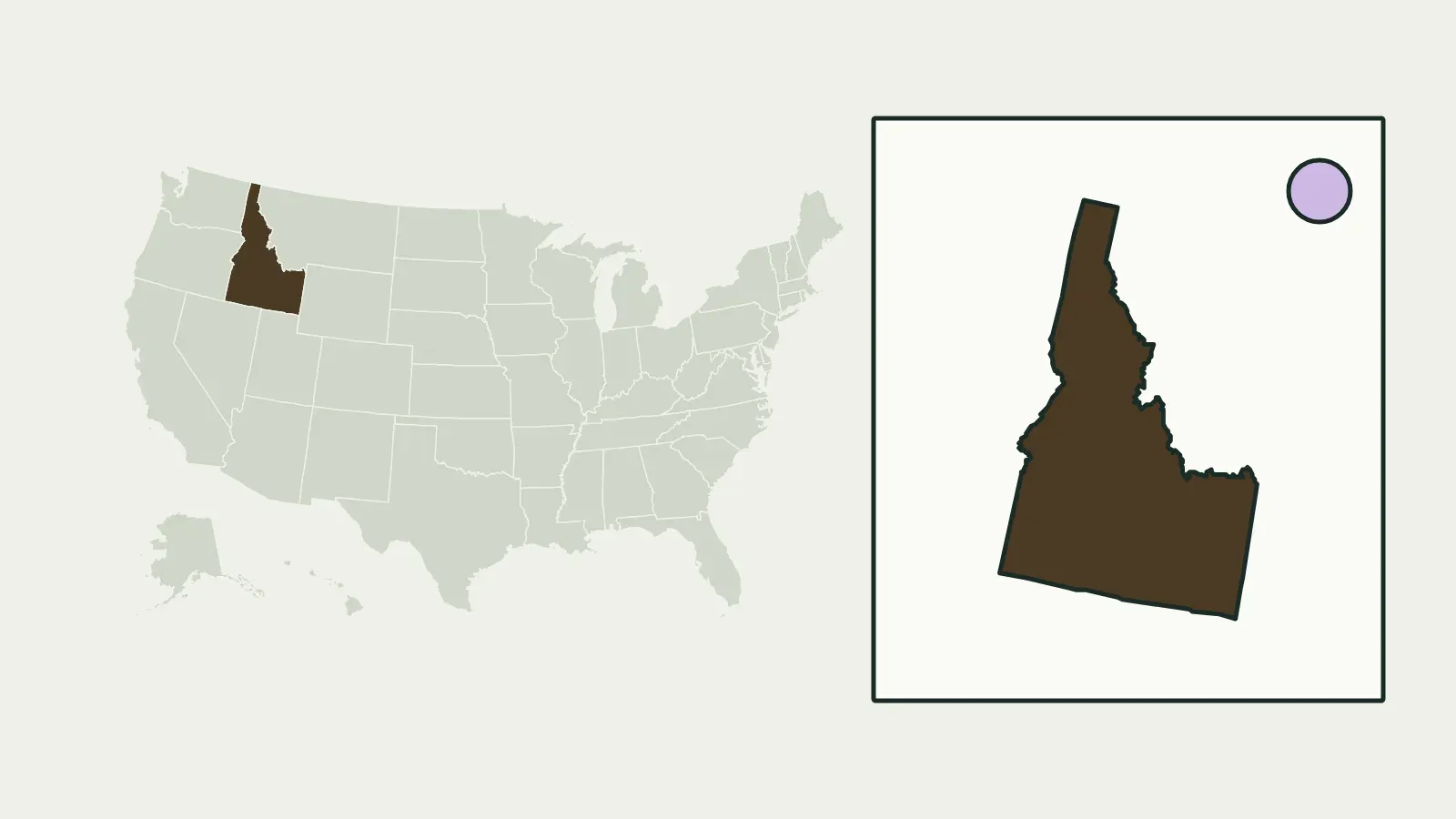
Idaho at a glance
Why Idaho has no numeric cap
Section 28-42-201 says that on a loan or credit sale the rate of finance charge "shall be that which is agreed upon between the parties." It does not limit how the charge is calculated, whether by add-on, discount or a single annual rate. On a precomputed loan, what you get back if you prepay is governed by the rebate rules in Section 28-42-307.
The National Consumer Law Center, which compares state caps, lists Idaho among the states with no numeric cap on a $2,000 two-year loan or a $10,000 five-year loan, only an unconscionability standard. Among states that do cap, the median is 34% APR on the $2,000 loan and 27% on the $10,000 loan.
How Idaho compares with its neighbors
| State | $2,000 two-year loan | $10,000 five-year loan |
|---|---|---|
| Idaho | No numeric cap | No numeric cap |
| Washington | About 29% APR | About 27% APR |
| Oregon | About 36% APR | About 36% APR |
| Nevada | About 40% APR | About 40% APR |
The $2,000 figures are current as of September 2025 and the $10,000 figures as of August 2023. Utah, also a neighbor, has no numeric cap either. The state rules map shows every state.
Who needs a license
Section 28-46-301 requires a license before anyone makes regulated consumer loans, or takes assignment of them and collects payments directly from borrowers. The Department of Finance's Consumer Finance Bureau issues it as the regulated lenders license.
- Supervised financial organizations, such as banks and credit unions, are exempt, as are lenders exempt under federal law and certain out-of-state deposit-taking lenders supervised by their own state.
- Online lenders that partner with a bank may make loans through that bank. Ask who the lender of record is and which regulator supervises it.
- Payday and short-term title lenders need a separate regulated payday lender license. Our sister site Lendmira covers those loans on its Idaho page.
How to protect yourself without a cap
Without a ceiling, the gap between two offers can be wide. As an example, not an offer: a $2,000 loan repaid over 24 months at 30% APR costs $111.83 a month and $2,683.92 in all. The same loan at 60% APR costs $144.94 a month and $3,478.56 in all, or $794.64 more for the same cash. The steps below keep you on the cheaper side of that gap.
- Compare the APR and finance charge on each Truth in Lending disclosure, for the same amount and term.
- Ask for every fee in writing, since Idaho allows other charges unless the Credit Code limits them. The net proceeds calculator shows what a fee taken from the loan leaves you.
- Get a quote from a credit union or your bank as well, so you have a second price to measure a finance company's offer against.
- Keep the agreement. If a term looks unconscionable, the papers are what a court or the Department of Finance will look at.
Check a lender and file a complaint
- Look up the license in the Department of Finance's licensee and financial institution search before you apply.
- Read the complaint guidance on the department's complaint page and gather your loan papers. How to verify a lender lists the warning signs.
- Call or write: the main line is 208-332-8000 and the consumer credit line 208-332-8002; the address is 11341 West Chinden Blvd., Building 4, Floor 3, Boise, ID 83714.
- Send a complaint to the CFPB as well if the lender is a bank or a bank partner.
Sources
- Idaho Code 28-42-201 — Maximum finance charge (Idaho Legislature)
- Idaho Code 28-45-106 — Unconscionability (Idaho Legislature)
- Idaho Code 28-46-301 — License to make regulated consumer loans (Idaho Legislature)
- Idaho Department of Finance — Consumer Credit
- State APR caps for $500, $2,000 and $10,000 installment loans, December 2025 (National Consumer Law Center)
We checked the facts on this page against these sources on October 27, 2026. Idaho's agreed-rate rule has been in the Credit Code since 1983; it was last amended in 1993.
Questions people ask
Is there a maximum interest rate on personal loans in Idaho?
No numeric one. Idaho Code 28-42-201 lets the parties agree on the finance charge. A court may refuse to enforce an agreement it finds unconscionable under Section 28-45-106.
What does unconscionable mean for an Idaho loan?
It is a court's finding that an agreement or clause was unconscionable when made. The court may then refuse to enforce it, strike the clause or limit its effect. A charge the Credit Code expressly allows is not unconscionable by itself.
Who licenses personal loan companies in Idaho?
The Idaho Department of Finance's Consumer Finance Bureau issues the regulated lenders license under Section 28-46-301. Banks and credit unions are supervised separately.
How can I check an Idaho lender?
Search the company in the Department of Finance licensee search. If it is not listed and is not a bank or credit union, ask under what authority it lends. See how to verify a lender.
Ask lenders for real offers
Describe the loan you have in mind. LendCedar passes your request to lenders and loan brokers who may contact you with offers; you compare them and decide.
- The loan you have in mind: amount, purpose, credit and income.
- Your contact details and your consent to be contacted.
- A lender or loan broker may contact you with an offer. Nothing is decided until you sign with a lender.
LendCedar is not a lender or a loan broker and does not make credit decisions.
You pay LendCedar nothing. Lenders and loan brokers pay us for requests, and they set their own rates and terms. How we make money.
Nearby in the guide
-
Offer term
Truth in Lending disclosures
The federal box line by line: APR, finance charge, amount financed, total of payments and what sits below.
-
Step
Verify a lender
Find the license on NMLS or with your state, match the lender of record and spot advance-fee scams.
-
Offer term
Net loan proceeds
What reaches your account when a fee is deducted, and how to gross up a loan to net the sum you need.