Personal Loans in Florida: What Licensed Lenders May Charge
Florida's Consumer Finance Act caps installment loans of up to $25,000 with three rate tiers. Here is how the tiers work since the July 2024 change, who needs a license, and where to check a lender.
Cap above 36%, by LendCedar Editorial Team Updated 6 minute read
In short
A business that makes consumer finance loans in Florida needs a license from the Office of Financial Regulation (OFR) under chapter 516 of the Florida Statutes. Section 516.031 caps interest by tiers: up to 36% a year on the first $10,000, 30% on the part up to $20,000 and 24% on the part up to $25,000, plus an investigation fee of up to $25. On a $2,000 two-year loan that allows about 37% APR, and on a $10,000 five-year loan about 36%. A loan that charges more than chapter 516 allows is not enforceable in Florida.
- $2,000 loan cap
- 37% APR
- $10,000 loan cap
- 36% APR
- Rate tiers
- 36% / 30% / 24%
- Licensed by
- Florida OFR
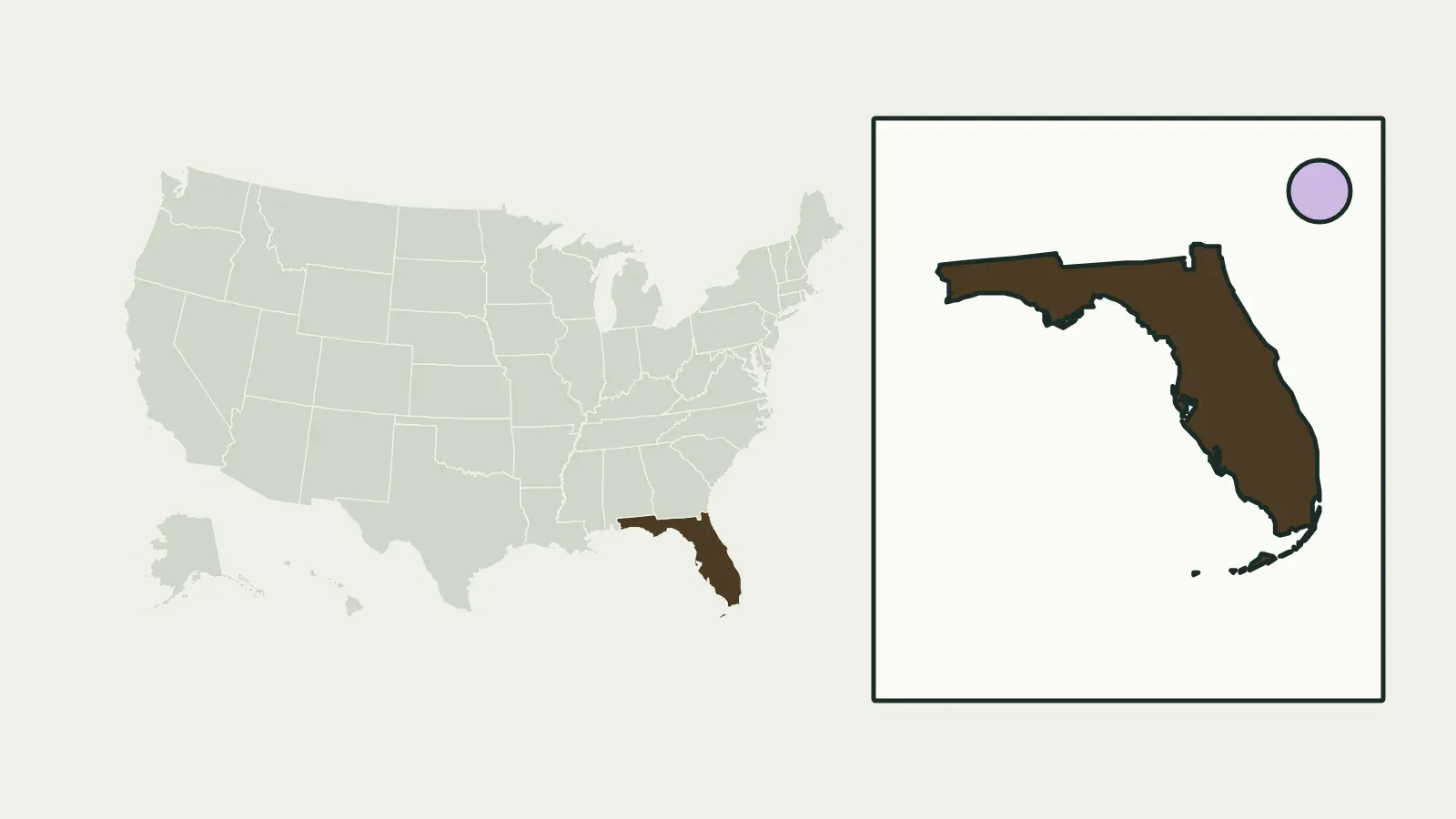
Florida at a glance
How the Florida rate tiers work
Section 516.031 lets a licensee lend up to $25,000 and sets the most it may charge as a yearly rate on each part of the principal. Compliance is measured as simple interest, not add-on interest, and the maximum APR is 12 times the maximum monthly rate.
| Part of the principal | Maximum yearly rate |
|---|---|
| Up to $10,000 | 36% |
| $10,000.01 to $20,000 | 30% |
| $20,000.01 to $25,000 | 24% |
These tiers come from chapter 2024-276, Laws of Florida (CS/HB 1347), effective July 1, 2024. Before that, the tiers were 30% on the first $3,000, 24% up to $4,000 and 18% up to $25,000. The change matters most for mid-size loans: a $10,000 loan can now be priced at 36% on the whole amount.
How Florida compares with its neighbors
On the National Consumer Law Center's comparison of a $2,000 two-year loan, Georgia caps that loan at about 32% APR, while Alabama has no numeric cap, only an unconscionability standard. The median among states with a cap is 34%. Your state of residence and the lender's license decide which rules apply. The state rules map shows every state side by side.
Who needs a license and who does not
Section 516.02 bars anyone from the business of making consumer finance loans, or running a branch of one, without authorization and an OFR license. Without that authority, a lender making loans of $25,000 or less is held to 18% a year. A loan with a rate or charges above what chapter 516 allows is not enforceable in Florida.
- Banks, savings banks, trust companies and credit unions operate under their own laws and are outside chapter 516.
- Online lenders that partner with a bank may make loans through that bank, which can put the loan outside the Florida tiers. Ask who the lender of record is.
- Payday loans fall under a separate part of Florida law. Our sister site Lendmira covers them on its Florida page.
Fees and borrower rights in chapter 516
Investigation fee
Up to $25 to cover part of the cost of checking your character and credit. It counts toward the finance charge, which is why the APR runs a little above the rate.
Late charges
Only on a payment at least 12 days late, and only if you agreed in writing. The cap is $15 for a monthly payment and $7.50 for a semimonthly one. See late fees and returned payments.
Bad check charge
If a repayment check is dishonored, the greater of $20 or the actual charge from the bank.
Paying early
A licensee may not charge a prepayment penalty for paying all or part of the principal early. See prepayment penalties.
Section 516.031 also bars splitting one loan into several, or running concurrent loans, to get a higher charge. If a licensee overcharges by a good-faith error, it must refund or credit the overcharge within 20 days of finding it.
Check a lender and file a complaint
- Look up the license with the OFR's Verify a License page before you apply.
- Keep the loan papers: the Truth in Lending disclosure, the agreement and any messages about fees. How to verify a lender lists other warning signs.
- File with the OFR through its Submit a Complaint or Tip page, or call (850) 487-9687.
- Send a complaint to the CFPB as well if the lender is a bank or a bank partner, or if you are unsure who regulates it.
Sources
- Florida Statutes 2026, Section 516.031 — Finance charge; maximum rates (Florida Senate)
- Florida Statutes 2026, Section 516.02 — Loans; license required (Florida Senate)
- Chapter 2024-276, Laws of Florida (CS/HB 1347), consumer finance loans
- Office of Financial Regulation — complaints and license verification
- State APR caps for $500, $2,000 and $10,000 installment loans, December 2025 (National Consumer Law Center)
We checked the facts on this page against these sources on October 27, 2026. The $10,000 figure is our calculation under the tiers in force since July 1, 2024, because the National Consumer Law Center's figure predates them.
Questions people ask
What is the maximum interest rate on a personal loan in Florida?
For a lender licensed under chapter 516, 36% a year on the first $10,000 of principal, 30% on the part up to $20,000 and 24% on the part up to $25,000, plus an investigation fee of up to $25.
When did Florida raise its consumer finance rates?
Chapter 2024-276, Laws of Florida, took effect July 1, 2024. It replaced tiers of 30%, 24% and 18% with 36%, 30% and 24% and moved the break points to $10,000 and $20,000.
Can a Florida lender charge me for paying off a loan early?
Not a chapter 516 licensee. Section 516.031 bars prepayment penalties on paying all or part of the principal.
How do I check a Florida lender's license?
Use the Office of Financial Regulation's Verify a License page. If the company is not listed and is not a bank or credit union, ask under what authority it lends before you apply. See how to verify a lender.
Ask lenders for real offers
Describe the loan you have in mind. LendCedar passes your request to lenders and loan brokers who may contact you with offers; you compare them and decide.
- The loan you have in mind: amount, purpose, credit and income.
- Your contact details and your consent to be contacted.
- A lender or loan broker may contact you with an offer. Nothing is decided until you sign with a lender.
LendCedar is not a lender or a loan broker and does not make credit decisions.
You pay LendCedar nothing. Lenders and loan brokers pay us for requests, and they set their own rates and terms. How we make money.
Nearby in the guide
-
Offer term
Total cost of a loan
Finance charge, APR and total of payments, with three worked offers for the same $10,000 loan.
-
Step
Verify a lender
Find the license on NMLS or with your state, match the lender of record and spot advance-fee scams.
-
Offer term
Prepayment penalties
Simple-interest vs. precomputed loans, the Rule of 78s, and the line that says if early payoff costs extra.